by Terry Heick
Exactly how can you tell if a student really comprehends something?
They learn beforehand to play the video game– inform the teacher and/or the test what they ‘would like to know,’ and even the best assessment leaves something on the table. (In reality, a large portion of the time pupils simply don’t recognize what they do not recognize.)
The concept of understanding is, of course, at the heart of all learning, and resolving it as a puzzle is just one of the 3 columns of official learning environments and education and learning.
1 What do they require to understand (requirements)?
2 What (and just how) do they presently comprehend (evaluation)?
3 How can they ideal pertained to comprehend what they presently do not (preparation discovering experiences and guideline)?
However just how do we know if they know it? And what is ‘it’?
Understanding As’ It’
Externally, there is difficulty with words ‘it.’ Seems unclear. Troublesome. Uncertain. Yet every person somehow recognizes what it is.
‘It’ is essentially what is to be discovered, and it can be a frightening thing to both educators and trainees. ‘It’ is everything, described with daunting terms like purpose, target, efficiency, examination, exam, quality, fail, and succeed.
And in regards to web content, ‘it’ can be almost anything: a truth, an exploration, a behavior, skill, or basic concept, from mathematical concept to a clinical procedure, the value of a historical number to a writer’s function in a message.
So if a trainee gets it, beyond pure scholastic efficiency what might they be able to do? There are numerous existing taxonomies and attributes, from Blossom’s to Comprehending deliberately’s 6 Facets of Comprehending
The complying with actions are established as a straight taxonomy, from many fundamental to the most intricate. The best component regarding it is its simplicity: Most of these activities can be executed merely in the class in mins, and do not require intricate preparation or an extended test duration.
By utilizing a quick representation, idea map, t-chart, discussion, photo, or short action in a journal, quick face-to-face collaboration, on an exit slip, or through digital/social media, understanding can be reviewed in minutes, aiding to replace testing and consternation with an environment of assessment. It can be also be displayed on a course web site or awaited the classroom to assist overview self-directed understanding, with trainees examining themselves for understanding.
Just How This Recognizing Taxonomy Works
I’ll create more about this quickly and place this into a much more visuals form quickly; both of these are critical in operation it. (Update: I’m also developing a course for educators to assist the, use it.) For now, I’ll state that it can be utilized to direct planning, analysis, curriculum design, and self-directed understanding. Or to create important thinking concerns for any content location
The ‘Heick’ finding out taxonomy is indicated to be easy, organized as (mostly) separated tasks that vary in intricacy from much less to much more. That claimed, trainees need not demonstrate the ‘highest possible’ degrees of understanding– that misses the point. Any capacity to finish these tasks is a demonstration of understanding. The majority of jobs the pupil can complete the much better, however all ‘boxes checked’ are evidence that the pupil ‘obtains it.’
36 Believing Approaches To Assist Pupils Duke It Out Complexity
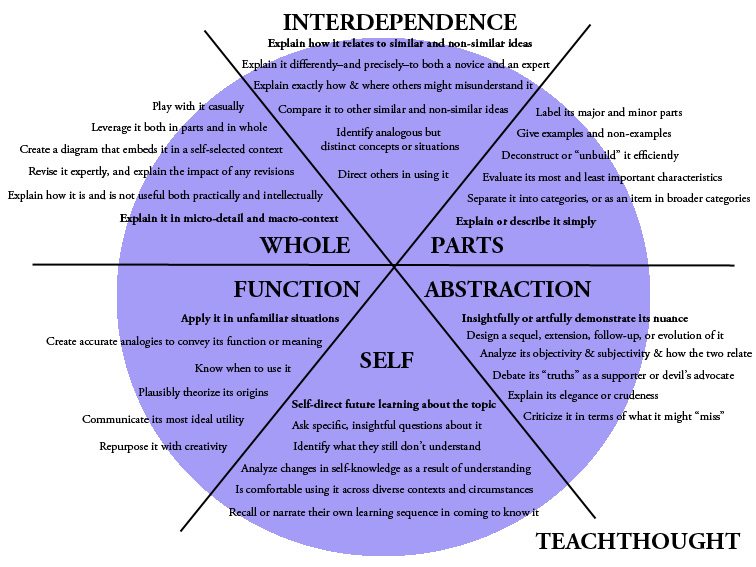
The Heick Learning Taxonomy
Domain 1: The Parts
- Describe or describe it merely
- Tag its major and minor components
- Evaluate its most and least important attributes
- Deconstruct or ‘unbuild’ it effectively
- Give examples and non-examples
- Different it right into groups, or as a product in broader classifications
Instance Subject
The War of independence
Sample Prompts
Explain the Revolutionary War in simple terms (e.g., an inescapable rebellion that developed a brand-new nation).
Recognize the significant and small ‘components’ of the Revolutionary War (e.g., business economics and publicity, soldiers and tariffs).
Review the War of independence and determine its the very least and most important characteristics (e.g., caused and effects vs city names and small skirmishes)
See also 20 Types Of Questions For Teaching Essential Thinking
Domain name 2: The Whole
- Discuss it in micro-detail and macro-context
- Develop a layout that embeds it in a self-selected context
- Discuss how it is and is not useful both almost and intellectually
- Play with it casually
- Take advantage of it both partly and in entire
- Revise it expertly, and clarify the effect of any kind of revisions
Domain 3: The Interdependence
- Explain just how it associates with comparable and non-similar concepts
- Straight others being used it
- Clarify it differently– and specifically– to both a novice and a professional
- Discuss precisely how and where others may misunderstand it
- Contrast it to other comparable and non-similar concepts
- Recognize analogous but distinctive concepts, ideas, or scenarios
Domain name 4: The Feature
- Use it in unfamiliar situations
- Develop exact analogies to communicate its feature or meaning
- Assess the wonderful area of its utility
- Repurpose it with creative thinking
- Know when to use it
- Plausibly theorize its origins
Domain 5: The Abstraction
- Insightfully or artfully demonstrate its subtlety
- Criticize it in terms of what it could ‘miss’ or where it’s ‘unethical’ or incomplete
- Dispute its ‘facts’ as a fan or evil one’s supporter
- Describe its style or crudeness
- Examine its neutrality and subjectivity, and just how both associate
- Design a follow up, expansion, follow-up, or evolution of it
Domain 6: The Self
- Self-direct future learning about the topic
- Ask certain, informative inquiries about it
- Recall or narrate their very own discovering series or chronology (metacognition) in coming to know it
- Is comfortable utilizing it throughout diverse contexts and scenarios
- Determine what they still do not comprehend concerning it
- Evaluate adjustments in self-knowledge as an outcome of comprehending
Advanced Recognizing
Comprehending by Design’s 6 elements of Recognizing, Bloom’s Taxonomy, and Marzano’s New Taxonomy were additionally referenced in the production of this taxonomy; a discovering taxonomy for recognizing